Somewhere around your fourth hour of screen time today, the dumb phone started looking like salvation. A brick that just calls and texts. No feed. No badge counts. Nothing to refresh. Tens of thousands of Americans type that exact wish into Google every month, and before you join them at checkout, you should know three things the product pages won’t lead with: what the famous one really costs, why the WhatsApp workaround died, and why the first year can quietly run toward four figures. We’ll get to that receipt.
Why everyone suddenly wants a dumb phone
The dumb phone revival is not nostalgia. Nobody misses T9 typing. What people miss is the version of themselves that existed before the feed: the one who read whole pages, sat through whole songs, stood in line without reaching for anything.
The science behind the urge is solid. Researchers at the University of Texas found that the mere presence of a smartphone drains measurable working memory, even when it’s face down and silent, and a 2023 meta-analysis of the studies since puts working memory at the center of the effect. Your phone doesn’t need to be open to cost you. It only needs to be possible.
A dumb phone makes it impossible. That’s the entire pitch, and it’s a good one.
What a dumb phone actually costs
The category runs on two tiers. At the bottom: sub-$100 flip phones, the Nokia-style bricks. Calls, texts, a camera that produces evidence rather than photographs. They work, in the way a shovel works. (I had a Nokia brick in primary school. The battery outlived two of my friendships. I’m not romanticizing it; the games were terrible.)

At the top sits the Light Phone 3, the category’s design icon. A 3.92-inch monochrome screen in an aluminum body, 124 grams, deliberately incapable of running a feed. It costs $699 right now, with the company’s stated plan to raise it to $799 once pre-orders close. Order one today and it arrives around September. Reviewers genuinely like it; Vice’s tester called it the most advanced dumbphone he’d ever handled, then laughed out loud at the price.
Here’s the part nobody prices in. Almost everyone who buys a dumb phone keeps their smartphone, because their banking app, their work 2FA, and their camera roll live there. So the real configuration is two devices, a second line or a SIM-swapping ritual, and a monthly carrier charge that never ends. The dumb phone doesn’t replace your smartphone. It supervises it, from a drawer, while you pay for both.
The Spotify problem. And WhatsApp. And maps.
Look at what dumb phone shoppers actually search: dumb phone with Spotify. Dumb phone with WhatsApp. Dumb phone with GPS. Thousands of these searches every month, and every one is the same confession. Nobody wants no phone. They want less phone, with their survival tools intact.
The market answers badly. WhatsApp ended support for KaiOS, the operating system behind most smart flip phones, which killed the classic cheap route to messaging on a brick; what survives is a thin shelf of stripped-down Android flips. Spotify is worse. No minimalist firmware streams it natively, and the Light Phone’s answer is syncing music files ahead of time through its own tool, like it’s 2004 and you’re loading an iPod. Maps is the one real win here: the Light Phone 3 ships turn-by-turn directions, and by most accounts they work fine.
Who should genuinely buy one
A dumb phone is the right call in three situations, and we’d rather lose a sale than pretend otherwise.
If you’re past negotiating, fully burned out, and want a clean amputation, buy the brick. If you’re handing a first phone to a twelve-year-old, a flip phone is a gift disguised as a punishment. And if you can genuinely run your life from one device with no banking app, no work codes, no rideshare, the Light Phone 3 is a beautiful object built by people who mean it.
Everyone else is about to spend $699 on a second phone they’ll carry on weekends, twice.
The middle path: make the phone you own dumb
You don’t need a dumb phone. You need your smartphone to shut up on command.

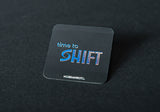
That’s the gap we built Shift to fill. It’s a physical device, a puck that lives on your wall. Tap your phone against it and the apps you’ve blacklisted go dark. Feeds, shorts, whatever owns you. Your camera still works. Your maps still work. Your banking, your WhatsApp, your Spotify, your work codes, all still there, because those were never the problem. Tap again when you choose to, and choosing means standing up and walking to wherever the puck lives, which is the same friction a dumb phone sells, minus the second device.
I write the Shift app, and the design brief was one sentence: keep the tools, kill the casino. The puck costs 199 zł, the app is free, blocking included, no subscription, and there are 5 emergency unshifts for genuine emergencies. If it changes nothing in 30 days, send it back.
The dumb phone asks you to abandon your smartphone. Shift makes your smartphone dumb on command, and undumb only when you’ve earned the walk.
Smartphone to dumbphone: the 30-day protocol
Whichever camp you’re leaning toward, don’t spend $699 on a feeling. Run the conversion on the phone you already own first.
- Days 1–3: get the number. Check your daily average in Settings, then take our Brain Rot Index for the uncomfortable version with a verdict. Write both down.
- Days 4–10: delete the single worst app. Not log out. Delete. Watch what your thumb does with the empty space; that reflex is the data.
- Days 11–17: strip the paint. Grayscale display, notifications off for everything that isn’t a human you know. The phone gets boring fast when it stops being colorful and loud.
- Days 18–29: dumb by default. Block the entire distraction list and make re-entry physical, with the Shift Puck on a wall or whatever friction you can rig. Live a full week where the feed requires a walk.
- Day 30: decide with evidence. Re-check your number. If it barely moved and you still ache for the brick, buy the brick; you’ll use it. Most people find the craving died somewhere around day 19, several hundred dollars before the checkout page.
The arithmetic
Receipt time, as promised. The Light Phone 3 is $699 today and $799 after pre-orders, before whatever your carrier charges for the second line, forever. That stack lands the typical two-device setup near four figures in year one.
Now the other column. Four hours of screen time a day is 1,460 hours a year. Sixty days. Two months of your waking life, annually, at current burn. Against that, a one-time 199 zł object is not really competing with a $699 phone. Both are competing with the sixty days, and either beats doing nothing by a margin that makes the price difference kind of beside the point.
Get Shift — 199 zł, 30-day guarantee
Frequently Asked Questions
For a full digital amputation, a kid’s first phone, or anyone who truly needs no smartphone tools, yes. For everyone else they tend to become an expensive second device, because banking, work codes, and group chats drag the smartphone back out of the drawer within weeks.
Mostly no. WhatsApp ended support for KaiOS, the system behind most smart flip phones, so the surviving options are a small set of stripped-down Android flip phones. If WhatsApp is non-negotiable, blocking distractions on your current phone is the more reliable route.
Not really. No minimalist phone streams Spotify natively in 2026. The Light Phone syncs music files in advance through its own listening tool, which works but means planning your music like a packed lunch.
The Light Phone 3 sells for $699 at the time of writing, with a planned increase to $799 once pre-orders close, and current orders ship around September. The phone plan is separate.
Run a 30-day trial on the phone you own before buying anything: measure your screen time, delete your worst app, go grayscale, then block your full distraction list with physical friction for a week. If you still want the brick on day 30, buy it with confidence.
Yes, and it’s cheaper: keep your smartphone and make the distractions physically inconvenient. Shift is a tap-to-block device that turns your phone dumb on command and keeps your camera, maps, and messages alive. One purchase, free app, no second phone number.

Both are competing with the sixty days.
Get Shift — 199 zł, 30-day guarantee →
More on Brain Fuel: The Phone Addiction Test · How to Reduce Screen Time