You sit down to study at 8. By 8:04 you've checked your phone twice, and by 9 you've read the same paragraph four times without taking any of it in. If you're looking up how to focus while studying, you don't need another list telling you to drink water and believe in yourself. You need the phone further away and a study method that keeps your brain too busy to wander. Here's the system, written for students who've already tried willpower and lost.

Why you can't focus while studying
Start with the honest part. Your brain isn't broken and you aren't lazy. You're trying to read about cell biology next to a phone full of apps designed to pull you back in.
Even when you don't pick it up, it costs you. In a 2015 experiment published in the Journal of Experimental Psychology, Stothart and colleagues had 166 students do a task that needs steady attention, then called or texted their phones without warning. Performance dropped even when they didn't touch the phone, and the authors reported that the distraction from a notification alone was comparable to actually using the phone. The buzz is enough. Your mind leaves the page and starts guessing who it was.
It also shows up in grades. A team at Rutgers University ran a term-long classroom experiment where devices were allowed in some lectures and banned in others. Their 2019 study in Educational Psychology found students understood the lecture fine in the moment, then did worse on the later exams for material from the device-allowed lectures. Even students who didn't use a device scored lower in those sessions. The damage happens later, when you need to remember it.
One thing we won't claim. You may have heard that a phone face down on the desk drains your brain just by being there. That 2017 study got a lot of press, and a pre-registered replication published in Acta Psychologica in 2022 found no effect from where the phone sat. The safer conclusion is narrower: a phone that can reach you will, and a phone you can reach, you'll check.
Set up the room before you open the book
Most focus advice is about trying harder once you're sitting down. It works better to settle things before you start, while you still have the energy to make good choices.
- Put the phone in another room. Face down on the desk still lets it buzz and still lets you grab it. Another room is best, or at least a bag on the far side of this one, so checking it means standing up.
- Kill the notifications that get through. Turn on Do Not Disturb so nothing lights up or buzzes. A buzz counts as a notification.
- Close everything you don't need on the laptop. One window for the material, one for notes. If the lecture slides are in a browser, close every other tab first.
- Write down the one task for this session. "Chapter 6, problems 1 to 10" is a task. "Study chemistry" is a mood.
- Put water and whatever you need on the desk now. Every trip to the kitchen is a trip past the phone.
If studying at your desk keeps failing, change rooms. A library or a quiet café corner works because you can't lie down there and you can't go back to bed.

Study in blocks, not marathons
Nobody concentrates for four straight hours. Trying to just means you spend the last three of them half-scrolling. Short blocks with real breaks get more done.
The simplest version is the Pomodoro Technique: 25 minutes of work, a 5-minute break, and a longer break after four rounds. If 25 minutes feels too short once you're warmed up, go to 45 or 50. The length matters less than the rule that the block has an end, so your brain stops bargaining for an exit halfway through.
The break rule nobody follows
Don't spend the break on your phone. Five minutes of a feed rarely stays five minutes, and when you come back your head is full of whatever you just saw. Stand up, refill the water, look out of a window, walk to the end of the corridor. Boring breaks are the point. They make the next block feel like the more interesting option.
Start smaller than you think
If you can't make yourself begin, the task is too big. Shrink it until it's almost silly: open the file, read one page, do one problem. Starting is the hardest part, and once you're moving the second page is easier than the first.
Use study methods that keep your brain busy
A lot of "I can't focus" is really "this method is boring my brain to sleep." Rereading and highlighting feel productive and ask almost nothing of you, so your attention drifts to find something that does.
The research agrees. In a 2013 review of ten common study techniques, Dunlosky and colleagues rated two as high utility: practice testing and distributed practice. Rereading, highlighting and summarizing were rated low.
- Test yourself instead of rereading. Close the book and write down everything you remember, then check. Use flashcards, past papers or the questions at the end of the chapter.
- Spread it out. Three 40-minute sessions across a week usually stick better than one two-hour session the night before. Distributed practice is the boring name for this.
- Ask why. Explaining to yourself why a step works, out loud if you're alone, keeps you active. The review rated that one moderate, which still beats highlighting.
Active methods help focus for a simple reason. When you're trying to recall something, there's no spare attention left over for wondering what's on your phone.
Lock the phone instead of negotiating with it
Everything above works on a good day. On a bad day, at 11pm with an exam in the morning, the phone in the other room starts to feel like a reasonable thing to go and check "just for a second." On those nights a plan won't hold, and a lock will.
There are a few levels, from soft to hard:
- Apple Screen Time. Free and built in, and you can limit the apps that eat your evenings. The weak spot is that you set the limit, so you can also switch it off. Our guide on how to reduce screen time covers how to make it stricter.
- A blocking app with no easy exit. The Nobrainrot app is free on iPhone. In Hardcore mode you can't end a session early, so the block holds until your study block does. Here's how the app works. On Android, read how to block apps on Android.
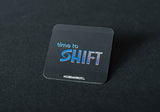
- A physical lock. Shift is a small puck with a magnetic wall mount. Tap your iPhone on it, and the apps you chose stay blocked until you tap again. Put it in the hallway and getting into Instagram means getting up and walking there, which is usually enough time to remember you're studying.
Pick the level that matches how often you've been losing. If Screen Time limits keep getting ignored by Tuesday, skip ahead.

When you still can't concentrate
Sometimes the phone is gone, the method is right, and your brain still won't land. Check the basics before you blame yourself.
- Sleep. A late night of scrolling costs you the next day's focus too. If you study at night, set your phone lock to end after you've gone to bed, not before.
- Food and movement. Studying hungry or after six hours of sitting is hard mode. A short walk before a session is a fair trade.
- The material itself. If you're lost, focus won't fix it. Go back one step, ask a classmate, or go to office hours.
- Overstimulation. If everything feels flat after a day of short videos, the book will too. Some quiet time before you start helps. Our piece on dopamine detox explains what's going on and what's hype.
If you can't concentrate on anything, in any setting, for weeks at a time, talk to a doctor or your university's student health service. That deserves a proper check, and a blog post can't give you one.
And if you want to know where you actually stand, the phone addiction test takes about two minutes. Nobrainrot users who keep a mode running for at least two weeks save 2 hours 13 minutes a day on average, measured in the app, and Shift is the strictest way to run one. For a student, that's a whole extra study session every day you didn't have to find willpower for.
Frequently Asked Questions
Put it in another room before you start, with Do Not Disturb on. If you keep walking over to get it, lock the apps you lose time to. A physical blocker like Shift keeps them locked until you tap the puck again, so checking means getting up and going to wherever it lives.
A little, but not enough. A 2015 study in the Journal of Experimental Psychology found that a call or text notification hurt performance on an attention task even when students didn't touch the phone. Silent with vibration still buzzes. Do Not Disturb and distance work better.
Start with 25 minutes on and 5 off, the Pomodoro Technique, and stretch to 45 or 50 minutes once that feels easy. Take a longer break after about four blocks, and keep breaks off your phone so they stay short.
Practice testing and spreading your sessions out over days. A 2013 review of ten study techniques rated those two highest, and rereading and highlighting low. Testing yourself also leaves less spare attention for wandering.
Decide the end time before you start, keep the phone out of the room, and set your app lock to run until after you plan to sleep. Late scrolling costs you the next day's focus as well as tonight's.
Yes, if it's hard to switch off. The Nobrainrot app is free on iPhone, and its Hardcore mode won't let you end a session early. Apple Screen Time is free too, but you can turn off a limit you set yourself.

Your phone can't interrupt you from the hallway.
Get Shift: 199 zł, 30-day guarantee →
More on Brain Fuel: How to Reduce Screen Time · Dopamine Detox

Залиш телефон. Заблокуй стрічку.
WhatsApp, Spotify і карти залишаються відкритими. Стрічка — ні.
Відправка за 48 год · На 30 хвилин менше щодня, або повернемо гроші