It’s 1 a.m. You meant to check one thing. Forty minutes later you’re four years deep in a stranger’s tragedy, your heart rate is up, and you feel worse than when you started — but your thumb keeps moving.
That’s doomscrolling. And before you blame yourself for it, you should know it was built this way.
What Doomscrolling Actually Is
Doomscrolling is the compulsive consumption of negative news and social content past the point you meant to stop. The word entered the dictionary as slang. The behavior is now a measured public-health pattern.
How common? A 2024 Morning Consult survey of 2,200 US adults found that 31% doomscroll “a lot” or “some.” Among Gen Z that figure jumps to 53%. Among millennials, 46%. More than half of an entire generation, caught in the same loop, most nights.
It isn’t random. The content that holds you is negative on purpose, because negative content holds everyone. Your brain is wired to treat threat as urgent — a survival feature that kept your ancestors alive. The feed found that wiring and built a business on it.
So no, you’re not uniquely weak. You’re a normal human running normal software against a machine designed to defeat it.
Why Your Brain Can’t Look Away
Two forces lock the loop. Understand both and the behavior stops feeling like a personal failing.
The first is negativity bias. Your brain weights bad information more heavily than good — it remembers the threat longer, reacts to it faster, returns to it more often. Research published during the COVID lockdowns found that doom-scrolling specifically mediated psychological distress, while neutral or positive scrolling did not. Same amount of time on the phone. Completely different effect, depending on the emotional charge of what you saw.
The second is the variable reward. You don’t know what the next swipe holds. Most of it is noise, but every so often there’s a hit — something shocking, something that confirms a fear, something you feel you need to know. That unpredictability is the same mechanism a slot machine runs on. Your brain keeps pulling because sometimes, just sometimes, it pays out.
The unpredictable reward is a dopamine loop. How dopamine drives this is worth its own read.
Put them together and you get a trap. The bad news spikes your anxiety. The anxiety makes you want more information to feel in control. More information means more bad news. The loop feeds itself.
Here’s the cruel part. Doomscrolling feels like coping. It feels like staying informed, staying ready, staying on top of it. It does the opposite. As one researcher put it, you see more and more to worry about while doing nothing to actually change any of it.

Bad news spikes anxiety. Anxiety demands more information. More information means more bad news.
The Sleep Tax Nobody Warns You About
Most doomscrolling happens in bed. That’s the worst possible place for it.
The American Academy of Sleep Medicine reported in early 2026 that 38% of US adults say viewing news on a phone before bed makes their sleep slightly or significantly worse. The mechanism is well documented: night-time scrolling activates threat-oriented thinking and cognitive hyperarousal, which directly interferes with falling and staying asleep. The screen light suppresses melatonin. The anxiety keeps the nervous system switched on. You lie there wired.
Then it compounds. Bad sleep lowers your emotional regulation the next day. Lower regulation makes you more susceptible to the next anxiety spike. The next spike sends you back to the feed. The sleep loss and the scrolling feed each other, night after night.
This is why “just stop before bed” doesn’t work as advice. By the time you’re in bed, the part of your brain that makes good decisions has already clocked out. The phone is right there. The willpower is gone.
Why Willpower Loses Every Time
You’ve tried to stop. Probably more than once. Here’s why the usual fixes fail.
“I’ll just put it down.” You won’t, because the decision happens at the exact moment your self-control is weakest — late, tired, anxious. Willpower is a morning resource. By midnight the tank is empty.
Notification settings. Helpful at the edges, useless at the core. You don’t doomscroll because of a notification. You doomscroll because you’re lying awake and the phone is the nearest exit from the discomfort.
Screen time limits. The “Ignore Limit” button is two taps away and you will tap it. Every time. Software that lives on the phone can always be overruled by the person holding the phone.
Following calmer accounts. Nice idea. The algorithm still serves you what keeps you scrolling, and what keeps you scrolling is rarely calm. You don’t control the feed. The feed controls the feed.
Every one of these shares the same flaw. The off-switch lives on the device that’s pulling you under, and you’re reaching for that switch at the worst possible hour. You cannot out-discipline a system built specifically to outlast your discipline.
How to Stop Doomscrolling — What Actually Works
The methods that hold up share one trait: they remove the decision from the moment of weakness and make it earlier, in daylight, when you’re thinking clearly.
Decide the rule before the moment, not during it. “No feeds after 10 p.m.” is a decision you make at noon. When 10 p.m. arrives, there’s nothing left to decide — the choice was already made by a calmer version of you.
Put real distance between you and the phone at night. Not on the nightstand. Across the room, or better, in another room entirely. The distance has to be far enough that retrieving it is a conscious act, not a half-asleep reach. The American Psychological Association’s guidance on technology and wellbeing consistently favors structural change over willpower for exactly this reason.
Replace the input, don’t just remove it. The doomscroll fills a need — usually the need to wind down or to not be alone with your thoughts. Take it away and leave a vacuum and you’ll relapse. Put a book on the pillow. A podcast queued. Anything that meets the same need without the threat content.
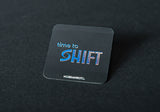
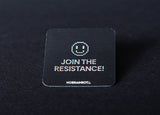
Use a hard, physical stop. This is where Shift comes in. It’s a physical device — you tap your phone to it and your chosen apps lock. At 10 p.m. you tap once and the feeds are gone until morning. To get them back you’d have to physically tap the device again, which is just enough friction that the 1 a.m. reflex meets a wall instead of an open door.

One tap at 10 p.m. The feeds are gone until morning. No negotiation at 1 a.m.
Track how you feel, not just how long. The number that matters isn’t screen time. It’s whether you feel better or worse after. Doomscrolling always scores worse. Once you start noticing that gap honestly, the habit loses some of its grip on its own.
The Tool We Built for the 1 a.m. Problem
I’m one of the founders of NOBRAINROT®. The 1 a.m. doomscroll was the exact problem we couldn’t solve with any app, because every app lived on the phone and every block was one tap from being ignored.
So we built Shift as a physical object that lives off the phone. A small puck or card. You tap your phone to it, the apps you chose lock. At night it sits on the far side of the room and the feeds are simply not available — not “available behind a warning you’ll dismiss,” but actually locked. The friction is the point. One physical act between you and the spiral is usually enough for the urge to pass.
It won’t make the news less bad. It just stops the news from owning your 1 a.m.
Get Shift — 199 zł, 30-day money-back guarantee
Frequently Asked Questions
It’s the compulsive scrolling of negative news or social content past the point you meant to stop. The term started as slang and is now studied as a real behavioral pattern linked to anxiety, distress, and poor sleep. The defining feature isn’t the time spent — it’s the negative emotional charge and the inability to stop.
Two reasons working together: negativity bias (your brain treats threatening information as urgent and worth returning to) and variable reward (you never know when the next “important” thing will appear, so you keep checking). It feels like coping or staying informed. In reality it raises anxiety without changing anything, which is why it leaves you feeling worse.
The research points that way. Studies have linked doomscrolling specifically — as opposed to neutral phone use — to higher psychological distress, and night-time scrolling to disrupted sleep through cognitive hyperarousal. A 2024 American Psychiatric Association poll found 43% of US adults felt more anxious than the year before, with current events a leading driver. If you already live with anxiety, a physical blocker like Shift takes the willpower out of the equation when you need it removed most.
Move the phone out of the bedroom, decide your cutoff time during the day rather than in the moment, and put a non-phone wind-down in its place. The single biggest lever is physical distance — if the phone isn’t within reach, the half-asleep reflex has nothing to grab.
Almost never, and the math favors stopping. The genuinely important news reaches you through other people, the next morning, regardless. What you lose by stopping is the noise. What you gain is your sleep and your baseline mood back.

Stop the 1 a.m. spiral before it starts.
Get Shift — 199 zł, 30-day guarantee →More on Brain Fuel: Brain Rot Is Real — And What It’s Doing to You · How to Reduce Screen Time — The Honest Guide