By June 4 you'll be able to slide on the Oura Ring 5 — the world's smallest smart ring, 40% thinner than the last one, yours for $399 — and it will know things about your body that you don't. Your resting heart rate at 3am. The minute your deep sleep fell off a cliff. It hands you a recovery score over breakfast and a soft suggestion to take it easy today. And it will be right. You did sleep badly.
It just won't tell you why.
You scrolled until 1:47am. You already know that. The ring only confirmed it, in a chart, the next morning.
We're the Most-Measured, Least-Rested Generation Alive
Oura isn't a gimmick, and this isn't a hit piece. The company has sold more than 5.5 million rings, and its CEO told CNBC it's on track for roughly $2 billion in sales this year. The Ring 5 is a genuinely impressive object — re-engineered from the inside out, a week of battery, sensors that read your pulse with more accuracy than anything on your wrist. People aren't wrong to want it.
Here's the part nobody puts on the box.
The average person now spends more than twice as long on the internet each day as they spend watching TV, according to DataReportal’s Digital 2025 report. Think about that for a second. Television — the thing every previous generation was told was rotting their brain — lost. By the time you’re 35, you will have handed something like a decade of waking life to a glowing rectangle.
That's not "screen time including your work laptop and the TV." A large share of it is the phone in your pocket, recreationally, on purpose, alone.
So we've arrived somewhere strange. We can measure our heart rate variability to the millisecond. We can see our sleep in four colored bands. And we are more anxious, more tired, and more distracted than any generation that came before us. We have never known more about our bodies. We have never done less about the thing that's degrading them.

The data is precise. The cause is obvious. The ring has nothing to say about it.
The Ring Is a Mirror. It Is Not a Door.
Open any review of the new ring and you'll read the same promise dressed in new language: more signals, more insights, more predictive power. The Ring 5 even adds "Health Radar," which watches your blood pressure patterns and nighttime breathing and flags early warning signs — real medical-grade ambition, built with more than 40 in-house doctors and PhDs. Impressive. Genuinely.
But notice what all of it is. It's a mirror. A very, very good mirror.
A mirror shows you the problem with perfect clarity. It does not move a single muscle on your behalf. You can stand in front of it for years.
Here's the reframe most people never get told: you do not have a data problem. You are not under-informed about your own life. You don't need a more accurate readout of how tired you are — you can feel how tired you are. What you have is an input problem. The same nights your ring marks red are the nights you fed your nervous system three hours of strangers, outrage, and blue light right up until your eyes closed.
A smart ring is a brilliant answer to the question "what happened to me last night?"
It has nothing to say about the question that matters: "what do I keep doing to myself, and how do I stop?"
What Actually Moves the Number
The wellness industry's default answer is willpower. Track more. Notice more. Be more disciplined. And it fails for a predictable reason: every software fix you've ever tried lives on the exact device that's defeating you. The screen-time limit pops up. You see "Ignore Limit." You tap it. The whole intervention takes 0.4 seconds.
The research on behavior change keeps landing on the same boring, unglamorous winner: change the environment, not the person. Make the bad choice harder to reach and the good one easier. Distance does what discipline can't.
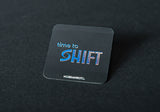
That's the entire idea behind Shift. It's a physical NFC puck. You set it down somewhere across the room — or another room entirely — tap your phone to it once, and your distraction apps lock. The off-switch finally lives somewhere your thumb can't reach from the pillow. No menu to override. No "just five more minutes" because the thing that ends it isn't on the screen anymore.
A ring tells you that you stayed up scrolling. A physical blocker like Shift makes it so you didn't.
The Guy Who Optimized Everything and Still Felt Like Garbage
A friend of ours — we'll leave him nameless — is the most quantified human you'll ever meet. Ring on the finger. Scale that talks to an app. He could tell you his average overnight HRV for the last quarter without checking.
He also slept terribly, and he knew exactly how terribly, every single morning, in numbers.
For a year his recovery score was a daily verdict he could do nothing about. He'd read it at 7am, feel briefly bad, and then spend the night doing the thing that produced it. He wasn't lazy. He was the opposite of lazy — he was informed. The data didn't change his behavior. It just gave him a more precise account of his own decline.
What finally moved it wasn't a better ring. It was a dumb rule: the phone doesn't come into the bedroom. He left it charging in the kitchen. The first three nights were genuinely uncomfortable, the way quitting anything is. By the second week his "score" — the one he'd stared at helplessly for a year — quietly climbed, and stayed there.
He still wears the ring. He just stopped asking it to do a job it was never built for.
The 7-Night Reset
You don't need to buy hardware to start this. You need seven nights and a rule you can't easily break.
- Tonight — pick the line. Decide on a hard cutoff time and a physical spot for the phone that is not your bed and not your nightstand. Across the room minimum. Another room is better.
- Night 2 — make it boring to retrieve. Put the charger over there too. The phone now lives there. Friction is the whole game: every extra step between you and the screen is a step willpower doesn't have to win.
- Night 3 — replace, don't just remove. Put a real book where the phone used to be. A void gets filled. Decide what fills it. This is the night people quit, so expect the itch and let it pass.
- Night 4 — automate the lock. Willpower is unreliable by night four. This is exactly where a tap-to-lock tool earns its keep. Set your distraction apps to lock at your cutoff so the choice isn't yours to renegotiate at midnight — the Shift puck was built for precisely this moment.
- Night 5 — protect the morning too. No phone for the first 30 minutes awake. The first thing your brain touches sets the tone for the day. Don't hand it to an algorithm before you've had water.
- Night 6 — notice the difference, not the number. How you feel waking up is the only metric that matters this week. You'll feel it before any app reports it.
- Night 7 — keep the one rule that worked. You won't keep all of these. Keep the one that bit hardest. Habits survive when they're a single decision made once, not a willpower tax paid nightly.
Push through the first week. Or don't, and keep scrolling. Up to you.

The single most effective intervention. Boring, obvious, and almost nobody does it.
What a Year of This Quietly Costs
Run the real math. If you reclaim even one hour a night from the scroll — modest, achievable — that's 365 hours a year. Fifteen full days. Awake. Yours.
That's not a productivity slogan. That's two weeks of your one life you currently spend horizontal, thumb moving, learning nothing, resting from nothing, slowly earning a worse recovery score for a ring to read back to you in the morning.
The Ring 5 will measure the cost of that year in beautiful detail. It will not give you the year back.
Why We Built a Piece of Plastic Instead of Another App
I'm one of the founders of Nobrainrot. We didn't build a tracker, because the world does not need one more device telling people how bad things are. People know. The exhaustion is not a measurement error.
We built Shift because the only thing that ever worked for us was distance — the phone genuinely out of reach, the off-switch genuinely off the device. So we made the off-switch a physical object you put across the room. Tap it, and your phone becomes a phone again. No score. No insight. No dashboard. Just your attention, handed back.
Wear the ring if you want the mirror. We're the door.
Frequently Asked Questions
If you want detailed, accurate health and sleep data in the smallest smart ring on the market, it's one of the best you can get — 40% smaller than the Ring 4 and built around serious sensing. Just know what it is: a measurement tool, not a behavior-change tool. It reports the problem with great precision but doesn't change what you do at night.
Indirectly, at best. Awareness can nudge a few people toward better habits, but for most, knowing your recovery score is bad doesn't stop the behavior that caused it. The thing that reliably improves sleep is changing your environment — getting the phone out of the bedroom — not getting a more accurate readout of how the phone wrecked it.
No. It tracks your body's signals — heart rate, temperature, breathing, sleep stages — not what's on your phone or how long you use it. That's the gap. The ring can show you that you slept badly without ever connecting it to the 90 minutes of scrolling that came right before bed.
Reduce the access, not just the awareness. Screen-time dashboards have existed for years and screen time has only gone up. Physical separation is what holds: a hard cutoff, the phone in another room, and a tool like Shift that locks your distraction apps with a tap so the decision isn't yours to undo at midnight.
Most people feel a real change in how they wake up within about a week — usually faster than any number on a tracker would confirm it. The first three nights are the hard part while your dopamine system recalibrates. After that it stops feeling like deprivation and starts feeling like relief.
Not at all. Keep the ring. It's a great mirror. Just stop asking it to be the cure — pair the data it gives you with an environment that actually changes the inputs.

Wear the ring. Then close the door.
Get Shift — 199 zł, 30-day guarantee →More on Brain Fuel: You're Not Weak. Doomscrolling Is Engineered. · How to Reduce Screen Time — The Honest Guide